


The marketing/purchase funnel
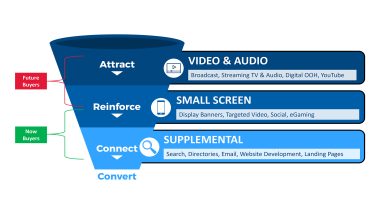
The marketing funnel (or related purchase funnel) is a visual depiction of a consumer’s journey through to conversion. While there are endless variations of this funnel, offering various levels, they generally break out into three sections:
- Awareness (Top)
- Interest/Consideration (Middle)
- Conversion (Bottom)
Top of the funnel focuses on brand awareness. These offer wide reach with high frequency, and are usually more cost effective for mass audiences. They have less refined targeting capabilities, however. This is the best level for marketing to future decision makers.
- Examples: Broadcast TV, Streaming TV, Streaming Audio, Digital OOH, YouTube
Middle of the funnel focuses on matching specific behaviors and characteristics. This is usually targeting “intenders” – those who are predicted to make a purchase decision in the near future. Middle of the funnel reinforces top of the funnel with added repetition to serious decision makers. This is the tradeoff zone between future and today buyers. Most of the time this audience is ready to make a purchase decision but are still considering their options.
- Examples: Display Banners, Targeted Video, Social, eGaming
Bottom of the funnel focuses on conversions of today buyers. This reaches the least amount of people, but they are people actively looking to make a purchase decision. As a result, the conversion rate (including click-through performance) is highest here, but don’t mistake that for the most overall clicks as the audience pool is smallest too.
- Examples: Search, Directories, Email, Website Development, Landing Pages
Some products may land in more than one level of the funnel depending on the level of targeting. YouTube, for example, can be both broad (top-funnel) and highly targeted (mid-funnel). But because most of the viewing now happens on a television it is often most effective as a branding tool. As well, sometimes consumers move both directions in the funnel as they consider their options.
It’s important to participate in each level of the funnel, but the allocation is going to differ depending on several factors, including your industry, existing brand recognition, level of competition, and purchase cycle. Weakness in your funnel strategy is an opportunity for a competitor to steal leads.